Sunday, May 6, 2007
Globalization and Islamic extremicism
Source:
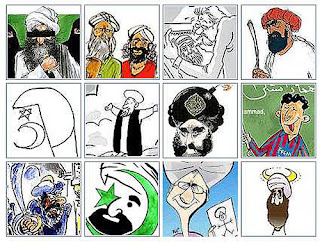
http://www.image-dream.com/membre/up/baronbleu/cartoons.jpg
Personal Response
Protests spread across the Muslim World last year over the publication in a Danish newspaper of cartoons of the Prophet Muhammad. The drawings which were first printed in the Jyllands-Posten, sparked a fresh row when they were re-run in several newspapers which eventually led to the sacking of the editor of a French newspaper. Above are some examples of the caricatures of Prophet Muhammad. The caricatures include drawings of Muhammad wearing a headdress shaped like a bomb, while another shows him saying that paradise was running short of virgins for suicide bombers. There is indeed enough animosity between Muslims and the West without this happening. Have globalization only made matters worst? The cartoons sparked diplomatic sanctions and death threats in some Arab nations, while media watchdogs have defended publication of the images in the name of press freedom.
I am sure that the growing unrest in the Islamic World is nothing new and something which most of us have heard about numerous times before especially after events such as 9/11 and London Bombings which have cast Muslims around the world in a somewhat negative light. But how far can they be blamed? Does globalization have anything to do with this? Is globalization a factor that contributed to the widespread protest of many Muslims around the world? Islamic fundamentalism is actually a product of globalization and uses globalization for its own benefit.
The controversy of the caricatures of Prophet Muhammad is a good example to show how globalization has resulted in the intense circulation of ideas and information globally, and increased the role of the media in doing so. In this case, the global media such as the internet and newspapers has fostered a common global Muslim identity, when there is actually no such thing as Muslims come from different areas and thus have different backgrounds. In the case of the caricatures of Prophet Muhammad, media such as the newspapers, internet and television circulated the cartoons around the world, resulting in many people having access to them. Before the globalization of media, the uproar would probably be more localized and not have been so intense since people who had access to the caricatures would have been limited. The fact that a comic strip in a small newspaper in Denmark managed to reach the global Muslim audience as far as Pakistan and Indonesia is prove of the global reach of current media forms.
On a similar basis, globalization has led to an increasing movement of people across borders. This can be seen in terrorists move between the West and Afghanistan resulting in the spreading of fundamentalist ideas, in ‘foreign’ American soldiers becoming increasing involved in sectarian violence in Iraq, in youths going to Pakistan to attend terrorist camps and coming back to the topic on the caricatures of Prophet Muhammad, in how quickly the caricatures angered the Muslim world. Furthermore with the existence of cheap phone calls and cheap flights people can communicate and move around more easily thus enabling ideas to be spread around more effectively.
Another factor is how globalization has resulted in increasing freedom of expression. Many people in the world feel that they have a right to express their feelings and opinions and in certain cases, do not consider the consequences of their actions. Getting back to the issue of the caricatures of Prophet Muhammad, the Danish press thought that they were not in the wrong as they believed in freedom of expression and refused to have this right limited in any way. However, the whole issue of the caricatures of Prophet Muhammad shows that freedom of expression can cause undesired events to occur and cause mush offence to certain groups of people. This is because globalization brings together many diverse groups with different values, increasing the chance of conflict.
In my opinion, people have to be very careful when they publish things that could potentially anger other groups. The caricatures of Prophet Muhammad is one example. Although people should be open minded and believe in the freedom of speech, this right should be used responsibly and with good judgment. Personally I feel that there has been an overreaction on both sides of the argument on this issue. The display of solidarity on the part of the European newspapers was an overreaction and rather foolish. On the other hand, having people make bomb threats against the newspaper is something which is going way too far. However, lessons can be learnt from this event such as the need to be more sensitive to other religions and cultures. To end off, I feel that globalization which has brought about the movement of ideas, the movement of people and the increasing reach of the media has increased the threat of conflicts between varying cultures, including the rise of religious fundamentalism.
Signing off,
Warda
Cultural Expert
Future Perfect; Cultural Expert
7:49 AM